













Automation has always offered a fairly straightforward bargain. Machines take on work that benefits from speed, strength, precision, consistency or sheer computational capacity, while people remain responsible for the parts that depend on judgment, experience, context, relationships and deciding what ought to happen in the first place.
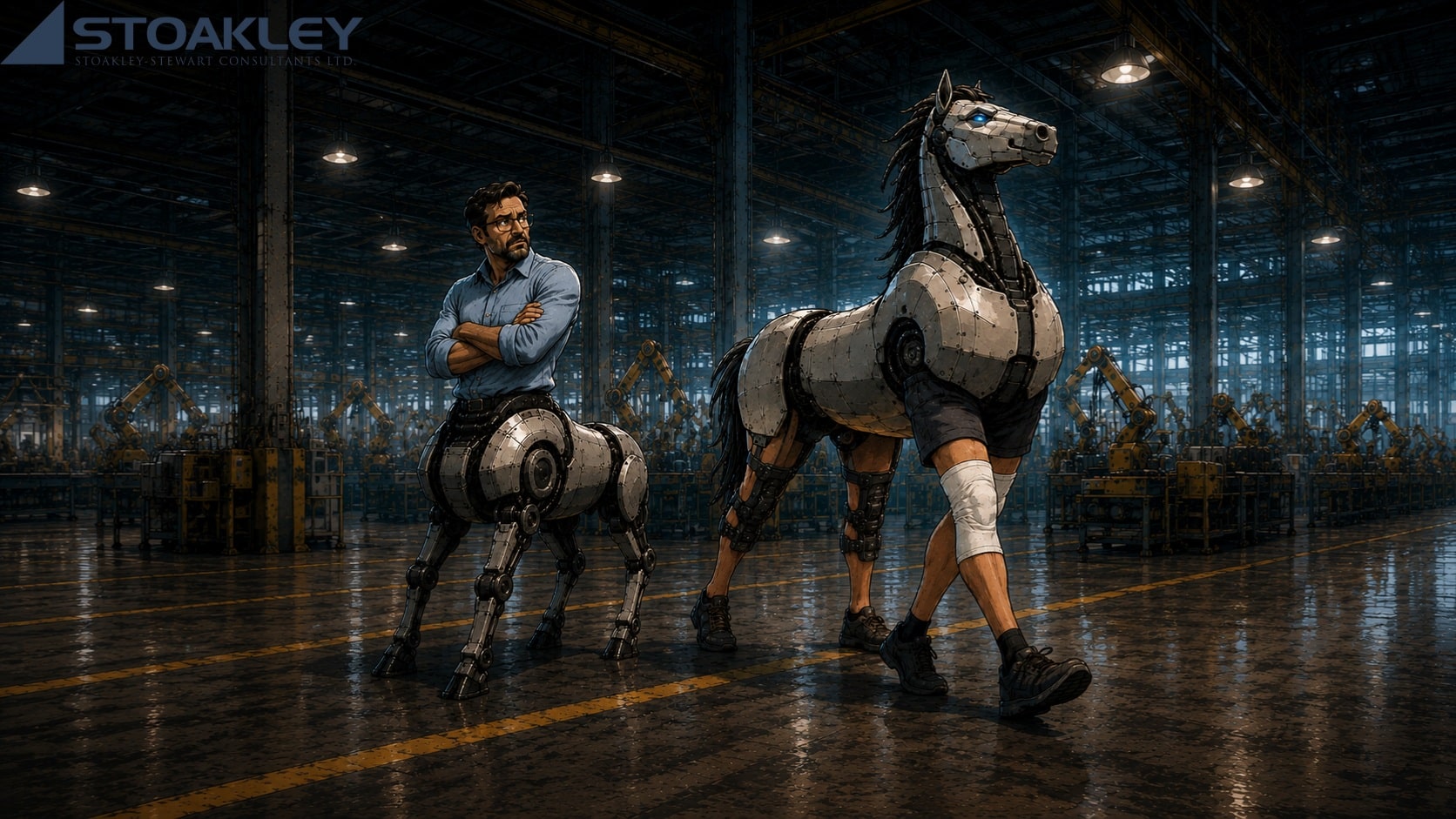
The centaur is a useful metaphor for that arrangement. The human is the head and the technology is the body. One supplies direction; the other supplies capabilities that the person could never possess alone. In manufacturing, logistics, engineering and many other fields, we have seen how effective that partnership can be when technology removes dangerous work, improves quality, increases output, reduces repetitive effort and gives employees better information and tools.
Doctorow’s reverse centaur describes what happens when that relationship gets turned around. Instead of the person directing the technology, the technology begins to organize the person’s work. The system establishes the sequence, pace, priorities and expectations, while the human increasingly performs the pieces that cannot yet be automated.
That distinction matters much more now that automation is moving beyond machinery and into scheduling, monitoring, analytics, workflow management and AI. Technology is no longer confined to carrying out instructions efficiently. It can help decide which instructions should come next.
For organizations investing heavily in automation and AI, we do not see that as an argument for backing away from technology. Quite the opposite. The opportunity is enormous. It does, however, make the design of the human-machine relationship something worth thinking about deliberately.
The distinction in simple terms
- Centaur: the human directs the work and technology expands what the person can accomplish.
- Reverse centaur: the system increasingly determines the work and the person performs whatever human tasks the machine still requires.
- The central issue is not automation itself: it is where judgment, authority and control ultimately reside.
The Centaur Was Never an Argument Against Automation
The original centaur works because people and machines are good at different things.
A manufacturing company does not improve by asking an employee to reproduce the consistency of a servo motor. Nor does a sophisticated piece of equipment understand a difficult customer, know why an experienced operator is uneasy about a process that technically remains within tolerance, or appreciate the organizational consequences of a decision simply because the numbers support it.
Good automation makes use of those differences.
A technician with better diagnostic technology can spend less time hunting for information and more time solving the problem. A production team with useful real-time data can catch defects sooner. A manager supported by better analytics can spend more time interpreting what is happening instead of assembling reports. A recruiter with stronger search and administrative tools can devote more attention to candidates, clients and the conversations where the actual recruiting work takes place.
In all of those examples, technology expands the person’s capability without replacing the person’s role in deciding what to do with that capability. That is the centaur we should want.
How the Relationship Starts to Reverse
The reverse centaur rarely appears because somebody intentionally designs a workplace around the idea that machines should command people. It is more likely to emerge through a long series of reasonable improvements.
Scheduling becomes automated because the software is better at it. Routing gets optimized. Productivity becomes easier to measure. A system allocates the next task. Another system monitors whether the task was completed on time. AI predicts demand and reprioritizes work as conditions change.
None of those developments is inherently problematic.
The change becomes more consequential when employees gradually lose discretion over how the work is performed. What comes next, how quickly it should be done, what counts as acceptable performance and when the next assignment begins may all be determined somewhere inside the system.
The person remains necessary, but increasingly because there are still things the technology cannot physically do, situations it cannot confidently interpret or interactions that require another human being.
If we take that arrangement far enough, the worker can end up functioning as a “meat appendage” attached to an extraordinarily sophisticated process: the remaining biological component required to lift, move, answer, intervene, reassure, repair or deal with whatever sits just beyond the automation’s reach.
We doubt many employers implementing automation actually want that outcome. It can nevertheless emerge if the only question being asked is how much more efficiently the system can operate.
Machines Get Faster Differently Than People Do
One of the underlying problems is easy to overlook because technological improvement and human improvement do not work in the same way.
Software can process twice as much information without becoming twice as exhausted. An AI system can evaluate another thousand records without developing eye strain. Automated equipment can complete another cycle without needing a better night’s sleep.
People can become more skilled and more efficient, of course, but our physical and cognitive limits do not move at the same speed as technological capability.
That matters when every gain in automation is translated directly into a new expectation for human throughput.
A system removes thirty seconds from a task, so the target rises. Better routing reduces travel time, so more stops are added. AI speeds up the administrative portion of a job, so the recovered time becomes additional volume. Gradually, the improvement that was supposed to create capacity becomes the reason the human part of the process is expected to operate closer to its limits.
Where efficiency can become fragility
Employees need some room to notice things, compare what they are seeing with experience, help a colleague, think through an exception or recognize that the process is producing an answer that does not fit reality.
From a purely mathematical perspective, that room can look like unused capacity. Operationally, it can be where much of the organization’s resilience lives.
AI Moves the Machine Further Upstream
Traditional automation often left a visible dividing line between the machine and the person. The equipment performed an operation; a person operated it, maintained it, inspected the result or decided when something needed to change.
AI makes that line much harder to see.
An AI-enabled system can recommend which customer should be contacted first, which maintenance issue deserves attention, which applicant appears most relevant, which employee should receive an assignment or which anomaly is likely to matter. Used in support of an experienced person, those capabilities can be extremely valuable.
Problems begin when recommendations stop being treated as recommendations.
There is a considerable difference between an experienced employee looking at a system’s output and deciding that the recommendation makes sense, and an employee following it because the process no longer gives them any meaningful reason or opportunity to do otherwise.
That distinction can be subtle from the outside. Both organizations may be using the same technology. The difference lies in whether the technology is informing human judgment or gradually replacing the conditions under which human judgment can be exercised.
Human Judgment Is Not Waste in the Process
Automation quite reasonably encourages organizations to look for friction, inconsistency and unnecessary variation. We should be doing that. The danger comes when everything that cannot be standardized starts to look like an inefficiency.
Much of the work that experienced people do well sits precisely in those irregular spaces.
- An experienced maintenance technician hears something unusual even though the readings remain within specification.
- A production employee notices that a material is behaving differently before the system registers a problem.
- A salesperson realizes that the objection being voiced is not the issue preventing the customer from buying.
- A manager notices a change in a normally dependable employee before a dashboard has anything useful to say about it.
- An engineer questions an apparently optimal recommendation because the assumptions behind it do not match conditions on the floor.
- A recruiter recognizes that a candidate whose résumé does not perfectly match a search may still possess exactly the combination of experience, judgment and potential an employer needs.
These are not mysterious human superpowers. They tend to come from accumulated experience, pattern recognition, context and knowing enough about the work to recognize when something deserves a second look.
As the routine parts of work become easier to automate, those capabilities should become more important in hiring and job design, not less.
A Better Automation Strategy Builds a Better Centaur
The answer is not to preserve every task because a person once performed it. There is plenty of work that machines should do, and there will be more of it as the technology improves.
The practical challenge is making sure that automation improves the overall job and the overall organization, rather than simply accelerating the portion that remains human.
These principles are not arguments against automation. They are part of using it well.
Better Technology Should Change What We Hire For
There is a common assumption that more automation should steadily make people less important. In many jobs, the opposite may happen.
When software handles the routine analysis, the person reviewing it needs enough knowledge to know when the conclusion does not make sense. As industrial equipment becomes more sophisticated, technicians need deeper diagnostic ability. If managers spend less time assembling reports, the quality of their actual management becomes easier to see. When AI can produce a competent first draft in seconds, subject-matter knowledge and judgment become more valuable differentiators.
The hiring profile changes accordingly.
Capabilities that may become more valuable as automation advances
- Judgment and decision-making
- Technical depth and practical experience
- Adaptability and learning capacity
- Curiosity
- Communication and relationship-building
- Problem-solving
- Leadership
- Customer understanding
- The ability to work through ambiguity
- Enough confidence and expertise to question a system when circumstances warrant it
These qualities are sometimes described as the things technology cannot do. We think that understates their value. They are also the qualities that help an organization get more from the technology it has.
Recruitment Strategy Has to Evolve Along With Automation Strategy
When technology changes a job, it is natural to update the job description around the new tools. Experience with a platform, familiarity with automation, knowledge of AI-assisted workflows and new technical requirements may all be relevant.
The more interesting question is what the technology has changed about the person the organization now needs.
If routine work has been automated, does the role require stronger judgment than it did before? If an employee is overseeing increasingly sophisticated equipment, does troubleshooting become more important than basic operation? If information is readily available, does interpretation matter more than information gathering? If AI generates recommendations, how much expertise does somebody need in order to recognize when a recommendation should not be followed?
Those questions affect recruiting in very practical ways.
Questions employers may want to ask
- What does this person need to understand that the system does not?
- Where will experience materially affect the result?
- Which decisions still require meaningful human discretion?
- What becomes more important in this job as other parts of it are automated?
- Are we hiring somebody to follow the process, or somebody capable of improving it?
- What knowledge could disappear if the role becomes too dependent on the system?
- Will capable people still want this job after the technology has changed it?
When we work with employers at Stoakley-Stewart Consultants, we are not simply trying to identify somebody capable of occupying whatever portion of a process still requires a person. The stronger hiring question is whether the candidate brings something that improves the system around them: experience, technical knowledge, judgment, leadership, relationships, problem-solving ability or an understanding of the work that technology cannot provide on its own.
Automation strategy and people strategy do not have to be developed by the same people, but they should know what the other is doing.
Human Talent May Become Harder to Differentiate — and More Valuable
There is another reason to be careful about reducing the human contribution too aggressively: technology spreads.
A new piece of software, an AI model or an automation platform may give one organization a meaningful advantage for a period of time. Eventually, competitors gain access to similar tools. Costs fall, capabilities improve and what was once distinctive becomes broadly available.
The people using those tools are harder to duplicate.
Two companies can install similar technology and get very different results because one has stronger managers, more knowledgeable technicians, better operators, more experienced salespeople or a culture in which employees are expected to think rather than simply comply.
The technology matters enormously, but access to technology is unlikely to remain a permanent differentiator by itself. How well an organization’s people understand, apply, question and improve that technology may prove much harder for competitors to reproduce.
That is another reason we still find the centaur useful. The advantage does not have to come from choosing between human capability and machine capability. It can come from combining the two better than everyone else.
Keeping Humans at the Head
The advances taking place in automation and AI give organizations opportunities that would have been impossible not long ago. We should make use of them.
At the same time, it is worth watching what happens to the human job as each new capability is introduced. If every improvement in the system simply increases the tempo expected of the person attached to it, the relationship eventually stops looking like augmentation and starts looking more like the reverse centaur Doctorow described.
Automation can remove work people should never have had to do in the first place. AI can surface information that would take a person hours to assemble. Machines can perform dangerous, repetitive and physically punishing work extraordinarily well. The value comes from deciding where those capabilities belong and making sure the people working alongside them still have meaningful room for judgment, expertise and responsibility.
For employers, that means treating technology strategy and talent strategy as connected subjects. For those of us in recruitment, it means paying closer attention to the human capabilities that become more valuable as the machinery, software and AI surrounding a job become more capable.
The centaur still works as a model because both halves bring something important to the arrangement. We should be careful not to lose the head.
Key Takeaways
- Automation and AI can improve work enormously. The important question is how the human-machine relationship is designed.
- The centaur model keeps human judgment in charge while technology extends human capability.
- A reverse centaur emerges when the system increasingly sets the pace, priorities and structure of the person’s work.
- Technological capability can scale much faster than human physical and cognitive capacity.
- Human judgment, practical experience, relationships and contextual understanding often become more valuable as routine work is automated.
- Automation initiatives should be accompanied by thoughtful job design rather than simply higher throughput expectations.
- Hiring criteria should evolve as technology changes what the human contribution to a role actually is.
- Organizations that combine capable people with capable technology may have a more durable advantage than organizations focused mainly on reducing the human role.
Keeping the Right People at the Head of the Centaur
As technology becomes more capable, finding capable people does not become less important. It becomes more important to understand what we need those people to contribute alongside it.
Employers: Keep Human Capability at the Head
As automation and AI change how work is performed, the people you hire alongside that technology matter enormously. Stoakley-Stewart Consultants helps employers identify professionals, technical specialists and leaders who bring the experience, judgment and capability needed to work with sophisticated systems, improve them and know when the situation requires something more than simply following the process.
Share Your Hiring NeedsCandidates: Find Work Where What You Bring Still Matters
Technology may change the tasks inside a job, but experience, judgment, ingenuity, technical expertise and the ability to solve unfamiliar problems remain valuable precisely because they are difficult to reduce to a process. Explore opportunities with employers looking for people who bring more to the organization than the ability to keep pace with the system.
Explore Career Opportunities